

Discord Alternatives Surge as Age Verification Changes the Platform
The Discord we knew is gone.
Starting this year, users are being defaulted into a “teen experience” unless they can prove otherwise. Not metaphorically. Literally. If Discord’s systems can’t infer you’re an adult, you’re nudged toward verification, sometimes through facial age estimation, sometimes through ID upload, sometimes through automated account analysis.
For a gaming chat app.
It’s part of a broader regulatory shift. The UK’s Online Safety Act is tightening obligations around underage exposure. US states like Ohio and California have introduced laws targeting youth access and online platform accountability. Big Tech is responding. Discord is responding.
And a lot of users are responding right back.
Search interest for “Discord Alternatives” reportedly jumped by as much as 10,000 percent after the announcement, according to screenshots of Google Trends data that circulated widely on Reddit and X. Whether that spike sustains long term is unclear. The reaction itself is not.
Sanctuary vs. Surveillance
Scroll through Reddit threads about the rollout and you’ll see it immediately.
Privacy concerns. Anger. Resignation. Some users talk about canceling Nitro. Others mention browser-based tools designed to trick facial age checks. A few sound genuinely conflicted.
One thread described Discord Alternatives searches skyrocketing overnight. Another fixated on third-party verification vendors. The tone wasn’t policy debate. It was personal.
I spent about twenty minutes reading through those posts. The vibe was raw. A few comments read like someone typing at 2:14 a.m. in a dark bedroom, monitor glow bouncing off the wall, trying to figure out why their comfortable digital hangout suddenly feels like a checkpoint.
That’s the tension.
Discord has always been part clubhouse, part chaos engine. Dark mode, open mic, random meme channels. Now imagine being asked to upload a government ID to keep accessing it.
It’s a jarring contrast.
And that contrast is what’s driving the surge in Discord Alternatives.
Why This Hit Harder Than Expected
Age verification laws aren’t new. Governments want platforms to protect minors. That pressure isn’t abstract.
But Discord doesn’t feel like a financial service or a passport office. It feels like a semi-private corner of the internet where usernames are weird on purpose and avatars are animated.
Now that space is being nudged toward real-world identity friction.
Discord says most adults won’t need manual verification because its age inference systems can confirm them automatically. It says ID uploads are deleted after review. It says video selfies don’t leave the device.
Those statements exist. The discomfort still exists.
There’s also a micro-contradiction here. People demand safer platforms for teens. People also recoil when safety measures feel invasive. Both impulses are valid. They don’t reconcile neatly.
Actually, they probably never will.
So users start looking elsewhere.
The Best Discord Alternatives Right Now
| Feature | Discord (Free) | Discord (Nitro/Paid) | Stoat | Fluxer | Matrix/Element | Mumble | Slack | Teams |
|---|---|---|---|---|---|---|---|---|
| Text chat (channels/rooms) | ✔ | ✔ | ✔ | ✔ | ✔ | ❌ | ✔ | ✔ |
| Voice chat | ✔ | ✔ | ✔ | ✔ | ✔ (client dependent) | ✔ | ✔ (paid) | ✔ |
| Video calls | ✔ | Enhanced | Partial* | ✔ | ✔ | ❌ | ✔ | ✔ |
| Screen sharing | ✔ | Higher quality | ❌ / Partial* | ✔ | ✔ | ❌ | ✔ | ✔ |
| File sharing | ✔ | Larger limits | ✔ | ✔ | ✔ | ❌ | ✔ | ✔ |
| Upload size limit | ~8 MB | ~500 MB | Community dependent | Up to 500 MB (paid) | Server dependent | N/A | Up to 1 GB | Integrated with OneDrive |
| Roles & permissions | ✔ | ✔ | ✔ | ✔ | ✔ | ❌ | ✔ | ✔ |
| Bots & integrations | ✔ | ✔ | Basic | Limited | Possible via bridges | ❌ | Extensive | Extensive |
| Custom emojis/stickers | ✔ | ✔ | ✔ | Planned / ✔ | Client dependent | ❌ | Limited | Limited |
| Persistent voice channels | ✔ | ✔ | ✔ | ✔ | Depends / mixed | Voice rooms | ✔ meetings | ✔ meetings |
| Self-hosting | ❌ | ❌ | ✔ | Possible | ✔ | ✔ | ❌ | Limited |
| Decentralized | ❌ | ❌ | Partial | ❌ | Fully | ❌ | ❌ | ❌ |
| Best for communities | High | High | Medium | High | Varies | Voice groups | Work | Work |
When people search for Discord Alternatives, they’re not looking for theory. They want something that works tonight.
Here’s where attention is shifting.
Stoat (formerly Revolt)
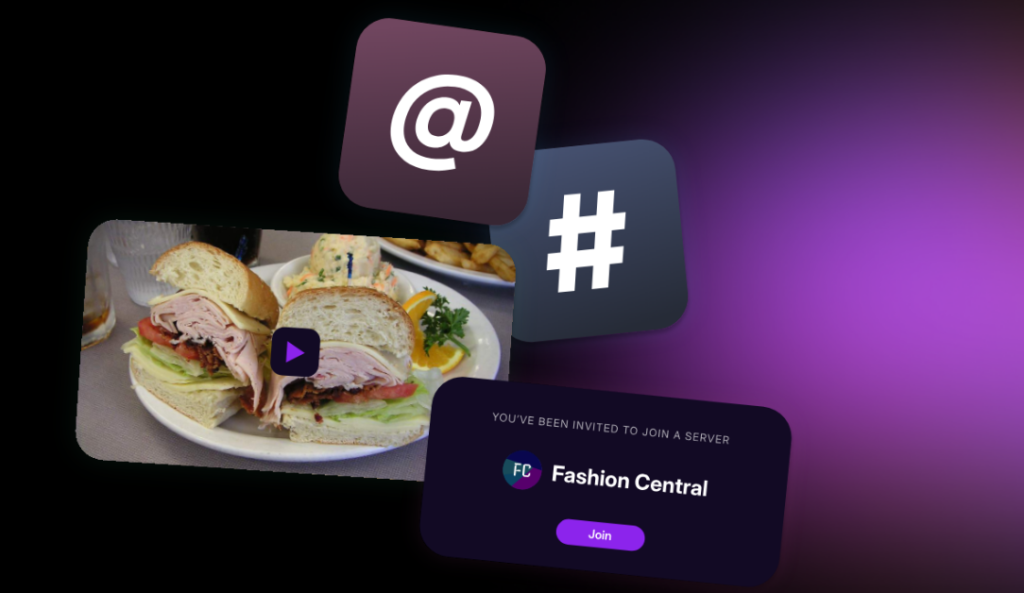
Stoat is the most direct Discord-style replacement. Same channel structure. Similar UI logic. Roles. Text. Voice. Moderation tools.
It rebranded from Revolt after legal and branding friction around the original name, a move that signaled the project maturing into a more formal identity rather than just a scrappy clone. The core mission didn’t change.
For most communities, Stoat feels familiar within minutes.
It’s open source. It can be self-hosted. It doesn’t hinge access on biometric checks. That matters.
If your priority is continuity, Stoat is the cleanest landing spot among Discord Alternatives.
Fluxer.app
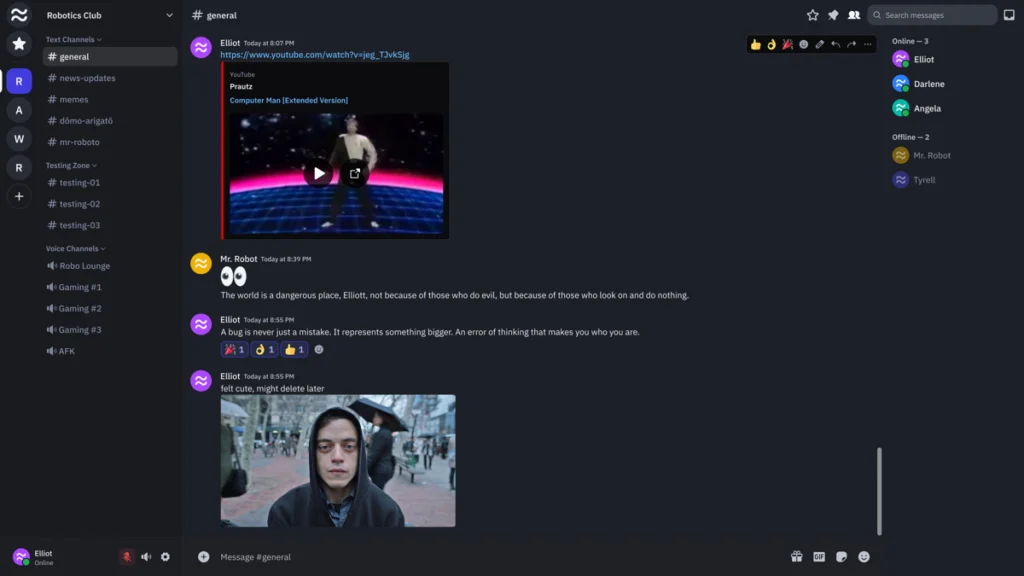
Fluxer is feature-dense. Text, voice, video, screen share, roles, moderation, file uploads. The free tier covers a lot. The paid Plutonium tier pushes further.
We’re talking 500 MB upload limits. Up to 4K at 60 fps video quality. Animated avatars. Custom themes.
That 4K 60 fps point is huge for streamers and power users who care about video fidelity.
Fluxer feels slightly more ambitious in customization. Slightly less mature in ecosystem scale. It’s powerful, but the surrounding community gravity is still forming.
Matrix via Element
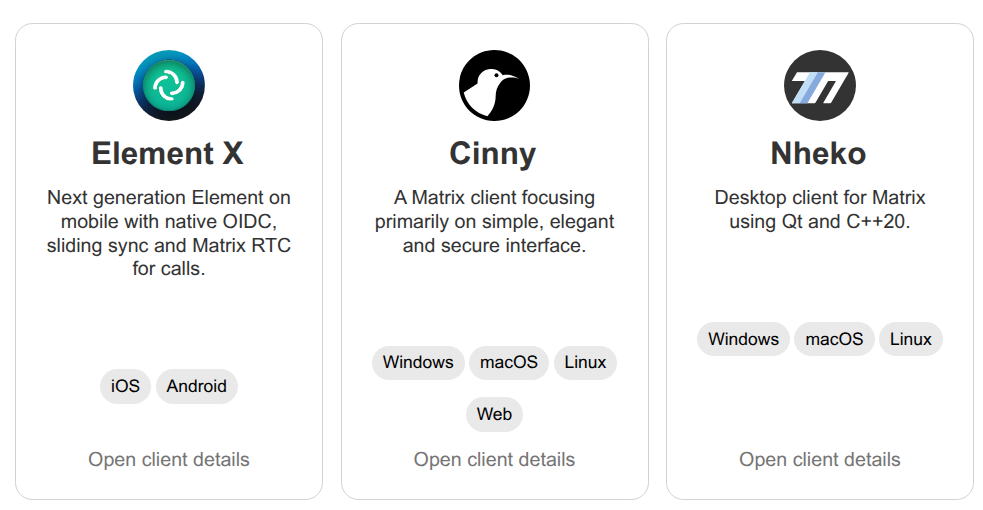
For the privacy hardliners, Matrix is the answer. Decentralized protocol. Optional end-to-end encryption. Self-hostable infrastructure.
Element is the most common client. It supports voice and video. It bridges to other networks. It also requires more technical comfort.
This is the choice if control outweighs convenience.
Work in Progress Platforms
This section deserves breathing room.
- Mumble Low-latency voice. Excellent for gaming sessions. Minimalist elsewhere.
- Tox clients Peer-to-peer messaging with audio and video support. Functional. Slightly utilitarian.
- Element on self-hosted Matrix Already mentioned, but worth repeating because this path splits the audience. It’s empowering. It’s also work.
These aren’t perfect substitutes. They’re evolving options.
Work-Focused Substitutes
Slack. Microsoft Teams. Zoom. Mattermost.
They handle channels, calls, screen sharing. They feel structured. They don’t replicate persistent drop-in voice rooms in the same organic way.
If Discord was your workplace, these can fill the gap. If Discord was your digital living room, the vibe is different.
And vibe matters more than people admit.
Quick Verdict for the Scrollers
- If you want the fastest, least painful transition: Stoat.
- If you’re a streamer or power user chasing video quality and customization: Fluxer.
- If privacy is your north star and you’re comfortable tweaking servers: Matrix.
- Those are the three real contenders among Discord Alternatives right now.
What Happens Next?
Will Discord backtrack? Unlikely.
Regulatory pressure isn’t easing. The UK Online Safety Act isn’t going away. US state-level legislation isn’t reversing course. Platforms adapt or face penalties.
So the question isn’t whether age verification expands. It’s whether users accept it.
The internet ran for years on pseudonyms and plausible deniability. Discord thrived on that energy. Now we’re entering something closer to credentialed participation.
Maybe most users will shrug and verify. Maybe the search spike for Discord Alternatives fades. Maybe communities migrate slowly, unevenly.
But the line has moved.
And once you’ve been asked to upload your ID to keep posting memes in dark mode at 2:14 a.m., it’s hard to pretend nothing changed.
Update: Discord Shifts Tone After Backlash
Discord recently moved into clarification mode. The company published an addendum emphasizing that the “vast majority” of users will not need to upload ID or complete a facial scan. According to Discord, most adults will be verified automatically through its internal age inference system. Only users who attempt to access age-restricted servers or adjust certain safety settings — and cannot be confidently classified as adults — will be prompted for additional checks.
Discord also stressed several privacy assurances:
- Facial age estimation runs entirely on-device and does not transmit biometric data.
- ID submissions are used only to confirm age, then deleted.
- The platform claims it only stores the resulting age group, not identity data.
- Message content is not used in the age inference model.
The messaging is clearly aimed at calming fears. The tone shifted from policy rollout to damage control.
For Some Users, It’s Already Too Late
The problem is timing.
By the time Discord clarified that most users would never see an age verification screen, screenshots, headlines, and viral posts had already framed the change as “face scans required.” In privacy-focused communities, the distinction between “most users” and “some users” doesn’t matter much.
On forums like r/privacy and across X, the backlash wasn’t just about verification prompts. It was about trust. The use of behavioral signals to infer age raised as many concerns as the ID checks themselves. For critics, automated age prediction feels less like a convenience and more like deeper profiling.
Some users report canceling Nitro subscriptions. Others are archiving servers or actively migrating to alternatives. Even if the majority never encounter a verification flow, the perception shift has already happened.
Discord may be technically correct that little will change for most people.
But culturally, something already has.